Saturday, 13 July 2013

LeeBogen Hits the Townships


For this beautiful summer (well in US terms- it’s actually winter over here on the other side of the world!), Ilana and I have been working at St. Joseph's Home (SJH), an intermediate healthcare facility that takes care of children in South Africa who have chronic illnesses or debilitating diseases. 
Here is a peak at some of the kids at SJH! 

As one of our two projects for SJH, Ilana and I had the opportunity to conduct pilot home visits in the townships for two weeks within the Cape Town area. In these visits, Ilana and I used a questionnaire we developed to evaluate the health of patients who were discharged six months ago, and to ensure their health has been maintained since they left SJH. As pre-med, public health majors, we were both ecstatic about being about to go into the homes of the children and talk to them and their families. Ilana and I have been in a township before when we were in Johannesburg (read more about it below in one of my friends' post!) so I didn’t expect the experience to be that different from what I had imagined, but little did I know what I was getting myself into…
One of the townships with houses of metal scraps & wood
This realization dawned on me as we started driving to our first home in Gugulethu, a small township not too far from the city center of Cape Town. Just as we left SJH, the rain started to pick up, the sky was gray, dark and gloomy, and the wind was picked up speed. Sitting in the back seat of a small white car from SJH, everything became much more real. I stared at the squeaky windshield wipers as various numbing sensations ran through my limbs. I couldn’t believe how nervous I was as I soaked it all in: I had no idea what kind of homes I was going to, and did not know what to expect since I had not been inside a home in the townships yet. Was it was going to be one built with cement? Or an informal settlement-type home made out of scraps of metal and wood in a shanty-town? The rain had made the situation scarier for me because I was not sure how safe it would be in an informal settlement with the rain pouring and the winds howling. Yes, I realize I seem like a chicken, but my imagination concocted an image of roof parts falling through while we were inside (I have a very active/crazy imagination- I don’t even let myself watch horror or mystery movies). I also had no idea how truly safe the neighborhoods would be since the crime rates in South Africa are high, and we would be more isolated in a township. Mary*, the social worker we were with, reassured us that she would not take us to dangerous areas, and I trusted her, so I tried to ignore my little worries.
Such a rainy, gloomy weather for our first day
However, Mary later said that people like to do “crazy things” when it rains, which definitely did not help appease my worries! She even told us stories about how people get hijacked in their cars while stopped at red lights in bad areas. We were traveling as a small group of women without always knowing where we were since Mary did not use a map, relying on her memory of the areas, which made me feel more vulnerable. I did not know if anyone would attack us, or try to hijack our car, or anything… and it raised a few goose bumps just thinking about the many possibilities all fabricated in my mind (with inspiration from the safety travel guide warnings I read prior to our trip here).
But even if I knew that the first home was going to be in a shanty-town, it would not have really stopped me from going. I had always looked forward to having the opportunity to truly see with my own eyes where the children live and what conditions they sleep, play and eat in, and to talk with the caregivers and children to hear what they have to say about their circumstances. I think I was just thinking overly cautious thoughts because of the depths of the unknown that lay before me. Besides not knowing the places we would be going, I also had no idea who would actually be at the home or what the whole experience was going to be like. I tried to focus on the idea that we would be able to see how the children were doing, and just took deep breaths (who knew yoga would come in handy?). After all, I knew ‘the unknown’ was always going to be a bit scary anyways so I wanted to push myself to do what I intended to do all along.
We arrived at our first home in Gugulethu as the rain started to pick up. The area consisted of cement homes that the government built. As I started to cross the grainy paths toward the house that was behind another house on the road, both my heart and thoughts picked up speed. Would the families be accepting of the foreigners at their doorstep? Our eclectic bunch at the home visits consisted of a Xhosa social worker, a Belgian social worker intern, and two American students- one German and one Asian (who was especially tiny). So, even before we entered the first home, I was not sure how the people there would respond to us, foreigners who arrived unannounced with clipboards and strange accents, asking them about their household and the child (note: we go unannounced so that we can see the children in ‘normal’, real circumstances and not have them ‘all cleaned up’). If I were them, I think I would be more afraid than angry, but I was not sure if we would be greeted with nervousness, anger, neutrality or something in between. Either way, how receptive they would be to us was completely variable, and I was not sure if I was ready to put myself in a situation that may make the people around me, who I just met, feel extremely uncomfortable. Despite these thoughts, I was already there and stepped into the home.
My first home visit went a lot better than expected- and I definitely had a nice sigh of relief. Sarah*, who was the cousin and caregiver of George*, a 10-year-old boy living with HIV, was not overly enthusiastic about us being there by any means, but she was accepting of us and okay with answering questions. This was a nice surprise because I didn’t feel like Sarah was holding anything back. We were able to find out that George is doing well with taking his ARVs, but he does not get a steady supply of food since Sarah is unemployed and cannot get a child support grant for George since he does not have a birth certificate. Hearing Sarah say it is hard to see a child suffering from starvation was heart breaking. Though Mary said we can drop off some food to help, I wished there was something I could do to help them with the long-term, and struggled to think of something helpful, which ended up being a constant challenge for me throughout the rest of our home visits.
Leebogen with our questionnaire in hand!
Though I was initially very nervous about going into the homes in the townships, I ended up being perfectly safe in the houses (including those of metal pieces) I walked into, and now realize how silly my worries were in retrospect. By the end of my first week, I was much more comfortable. This allowed me to focus more importantly on connecting with the families and figuring out what parts of our questionnaire works, which will hopefully be a useful tool for SJH once Ilana and I (quite sadly) leave. I was also able to get a sampling of the true joys and disappointments that the SJH social workers probably go through as they learn about different children’s circumstances. I loved seeing the children who were maintaining their health at home, but it was difficult to see that some kids do not have access to basic things to maintain their health like treatment or food. I was outraged, zealous and disappointed throughout my experiences, and it was weird to go back and forth from the various extremes of emotions so often. However, I would not have traded my emotional journey for anything. I only hope that Ilana and I have truly helped gauge the successes of SJH’s help of giving the children the tools to better health, and also help ‘catch’ some of the kids who are struggling with maintaining their health after SJH, and get them the care they need. LeeBogen** over & out.

*Names have been changed for confidentiality reasons
**LeeBogen is the nickname for Ilana and I

Written by Jessica Lee

Friday, 12 July 2013

Home Sweet Langa

The 14 of us were excited as we rolled into Langa last Thursday night, eagerly talking about the weekend and our prospective host families. For the next three nights we would be living in Langa, the first formal township of Cape Town known for its history and close-knit community. By that time I had spent a lot of time in the township of Phillipi during my work with Ons Plek, but it was exciting to see the differences between two townships, and I was happy to be able to live in one instead of leaving every afternoon at 4pm.
Mama Mandaba taught us how to make bread!
            We spent Thursday night dining at a tiny restaurant in the middle of a residential neighborhood, and we marveled over the huge buffet and delicious fresh-baked bread. As the evening wore on, we were entertained by live music, dancing, and mingling with part of the Langa community. Finally, it was the moment we were all waiting for: who would be our “parents” for the weekend? Jessica and I got introduced to a middle-aged woman with glasses and a headscarf, who gave us firm hugs and told us to call her Mama Mandaba. We would be living at her house for the weekend, alongside her, her grown son Lunga, and her 8-year old grandson Hlomla.
            That night, Jess and I got a brief tour of the house before bed. The house had five rooms: a front living room, a small kitchen, a bathroom (no hot water or shower though), and two bedrooms. Jess and I were given Lunga’s bed to sleep in, while Hlomla slept with his grandmother and Lunga graciously slept on the floor.
            What shocked me most about the house wasn’t the lack of hot water, or the basin we would need to use to bathe, or the black mold on the ceiling of our bedroom, but the enormous TV that was in Lunga’s room. It was a huge flat-screen TV, bigger than most I see in America, with multiple speakers and a DVD player attached. This turned out to be a theme in Langa, and in most of the townships of Cape Town. No matter how stretched for resources a family may be, they always had a television.
I told you they had a huge TV! (And yes, we were watching Madagascar)

            Over the weekend I really got an appreciation for what life would be like if I were to actually live in Langa. On Friday, Hlomla, Andre, Andre’s host brother Zibele and I went to the supermarket because I had forgotten to bring a towel. I perused the aisles while Hlomla tried to persuade me to buy him some chocolate ice cream (he was successful). I got more than a few curious glances, however Hlomla and Zibele made me feel totally comfortable. That evening we went to the local tavern, Tiger, to drink and hang out with the older members of our host families. Mama Mandabe and Lunga weren’t there (“I’m too old to groove” said Mama), but I had a great time mingling with the other families.
            My favorite activity of the weekend was our Saturday trip to Mzoli’s, a famous braai (barbeque) joint in Gugulethu. We spent the entire afternoon there, drinking hard cider, dancing to African-influenced club music, and eating the most delicious chicken and sausages I have ever had.
Mzoli's: a carnivore's paradise

            Despite the delicacies of Mzoli’s and the drinks and Tigers, the best part of my weekend was getting to know my new family. Mama Mandaba is an awesome cook, and Jess and I learned how to make fresh bread (delicious!) and vinegar-porridge (less delicious). Lunga worked long hours as a taxi driver and came home late at night, but always spent time watching TV and chatting with me and Jess. My favorite family member, however, was Hlomla. We became very close over the weekend, and he was the adorable, entertaining, mildly-overwhelming kid brother I never had. At eight years old he was in the hilarious transition between childhood and adolescence. During the day, he would run around with his friends, dancing to rap songs and getting into trouble. In the early mornings though, he would try to crawl into bed between me and Jess and snuggle until his grandmother called him to breakfast. One of my favorite memories was walking through Langa with him on Saturday morning to visit his mother’s house. We chatted talked about living in the township and he tried to teach me some words in Xhosa as we walked hand in hand.
Me and Hlomla, being silly at the end of our trip

            Living in Langa was fun and endlessly educational, but it wasn’t comfortable. In addition to having no hot water, I woke up on our last morning with over 60 mysterious bug bites which I’ve spent the last week itching. Despite this, however, I am immensely glad that we had this opportunity. To write about everything I felt and experienced would take pages and pages (but feel free to talk to me about it if you have any questions!). Staying in Langa really let me experience daily life in the townships, and shifted my perspective about how many of the things I deem “necessary” for living are really just luxuries. I learned that it doesn’t really matter what you have in your home; it’s the people you fill it with that makes all the difference.


A few of my lovely bug bites...should I be alarmed?


Written by Leah Rosenbaum
            

Soweto Bike Tour


Soweto
Hello South Africa! After an 18-hour flight, we arrived in Johannesburg at 5:30pm June 4th, 24 hours after we had left Dulles, and hopped on a bus to head to Soweto where we’d be spending our next three days. Soweto is a township southwest of Johannesburg (hence so-we-to). We spent our first three nights at Lebo’s Backpackers, a hostel where we slept 6 and 8 to a room. The close quarters provided for a crash course of getting to know everyone and any sort of group awkwardness was resolved in those first three days. We didn’t waste a minute to start learning about South Africa because the next morning after flying in, we took a bike tour of Orlando West, the neighborhood that Lebo’s Backpackers is in. That morning, exhausted and jet-lagged, we hopped on our rickety bikes (or hopped in our tuk-tuk), strapped on our helmets and set out to learn the history of West Orlando. After starting our bike ride up the hardest hill of the day, we stopped at the top to rest and look out over the rest of Orlando West as well as Orlando East and over towards the mine dumps that blocked the view of Johannesburg. There we were introduced to Soweto and all of its culture and pride. Our tour guides began by performing the official song of Orlando West that we all know as The Circle of Life. The song was originally written and created by a man from Orlando West and he sold the song to a man in New York who adapted it and placed it in the opening scene of The Lion King. The opening of the song is in isiZulu, one of South Africa’s eleven official languages and the mother tongue of the province Guateng where Johannesburg is. Our tour guides then proceeded to teach us a few isiZulu words that would allow us to greet people. One way to say hello is sanibonani and the response is yebo. We were also taught that if someone says “shoot me” there are asking for their picture to be taken and it is custom to show them the picture you had taken of them.
Our tour guide holding the traditional beer
Cow cheek and pap


From there we continued through a middle class area of Orlando West comprised of modest brick or plaster houses. We then proceeded to the poorest part of Orlando West and got our first experience of what a township is and the poverty and wealth disparities that South Africa faces. In this area, many people live in metal shacks and make use of communal taps for water and communal bathrooms where there are only six to a street and the sewage creates streams within the dirt streets. Yet despite the poor living conditions, everyone was welcoming and there many instances where I was able to put my newly learned Zulu to use. While there, we were introduced to shebeens, a small hut that illegally sold alcohol during apartheid years, but now is just used as a place to hang out and drink. We were given the chance to go inside and try their local homebrewed beer. Before leaving, those of us who were willing, tried their local delicacy, cow cheek. They serve it with salt and paprika and a corn porridge called pap. All I have to say is thank goodness for the beer that they had to wash down the meat.
Hector Peterson Memorial -
Hector is the boy being carried by a fellow classmate

We then continued on to one of South Africa’s major landmarks of history, the Hector Peterson Memorial. On June 16th, 1976 students in Soweto peacefully marched to protest the use of Afrikaans, a language of apartheid, as a teaching medium in schools because black students did not speak Afrikaans. The students met resistance by police and it quickly escalated to violence. Students were shot by the police and this is where the famous picture of Hector Peterson, a 13-year-old boy who was shot and killed, came from. Today, June 16th is a national holiday and is called Youth Day and students within Soweto wear their school uniforms to show their respect for those who stood up to the apartheid regime. Our tour guide had told us that he was planning on wearing his old school uniform on that day. Hearing the story of apartheid from someone who was too young to experience it highlighted how deep these issues are and that they are still affecting our generation today.
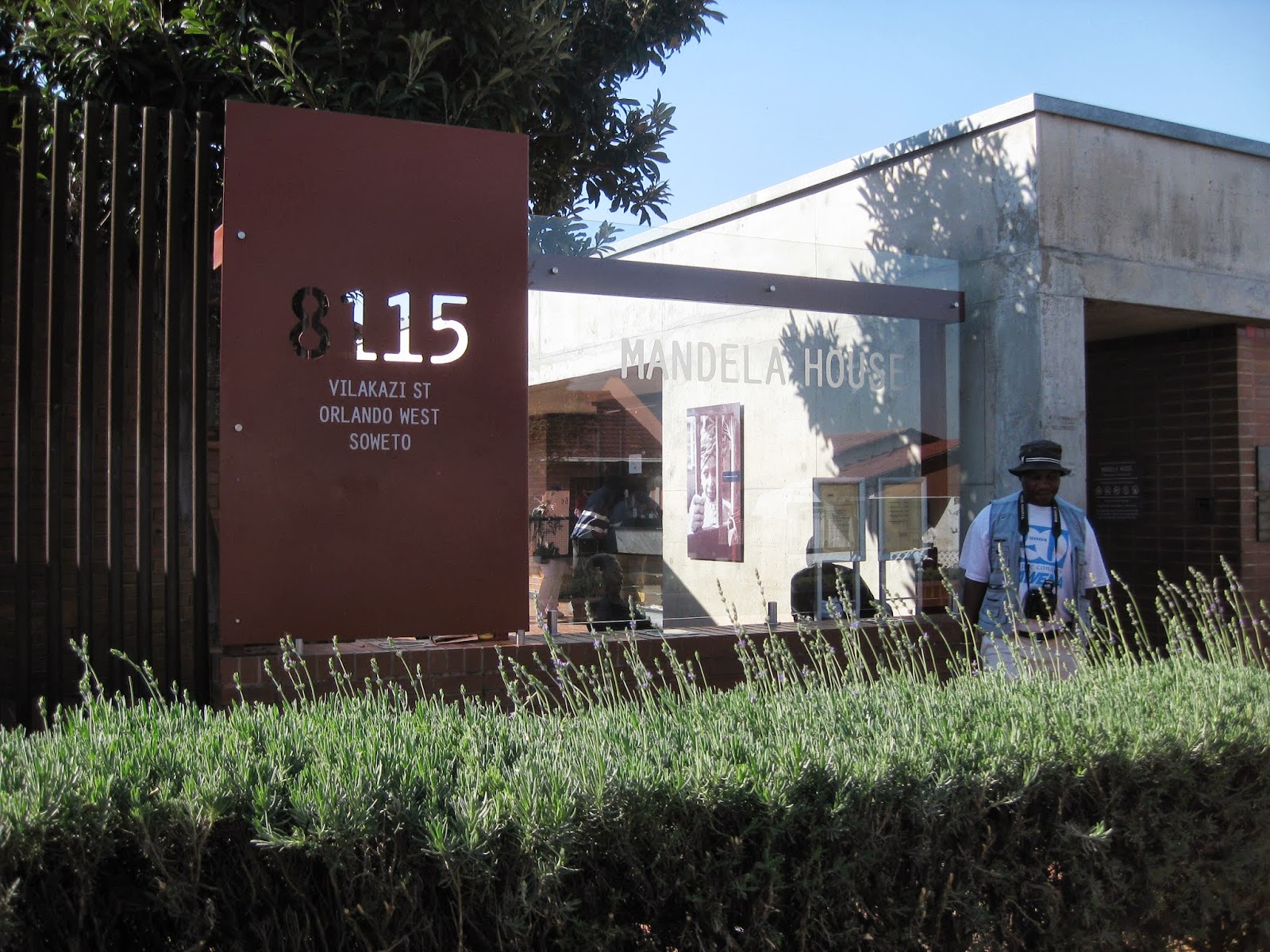
Nelson Mandela House
            
          We ended our bike tour by riding through the main road of Orlando West and seeing the houses of Nelson Mandela and Archbishop Desmond Tutu. Orlando West, Soweto is the only place in the world where two Nobel Peace Prize winners lived on the same street. Nelson Mandela lived in his Orlando West home from 1946 and into the 1990s before becoming president. Mandela’s home is now a museum for those to visit and learn about the history of him and his family. Desmond Tutu’s house, just a few blocks down from Mandela’s, is still a private residence with some of his family members living there.
            After only a few hours on our bikes, we had learned an incredible amount of history and the legacies of Soweto and specifically Orlando West. Despite the hills and a good amount of physical exertion less than 24 hours after landing in Johannesburg, the bike tour was the perfect way to be introduced to South Africa. I’m glad that we weren’t eased into the drastic cultural differences between the states and South Africa. I think that if we had visited Soweto after Cape Town or even after we visited the museums in Johannesburg, our experience would have been different in that we would have already been partially sensitized to the disparities in South Africa. Taking the bike tour the first day we were there gave me the opportunity to immediately experience the culture shock and go through the feelings of being lost, disbelief, and awe as well as anger that people have no choice but to live in these conditions. I think it’s still something many of us still struggle with when visiting and working in the townships in Cape Town, however it’s inspiring to see the camaraderie and hospitality that people who live in townships have with each other and visitors.


Street in the township

Written by Amanda Masse

Diving with Sharks - Casual


The Cage
South Africa is known to have one of the largest Great White Shark populations in the world. As a group, we decided to get a closer look!

And boy, did we get close . . .

Shark cage diving - a basic overview of the process.

1.) A short boat ride out to sea. This seems like the most relaxing part of the trip, right? Unfortunately, this was a struggle . . . over half of our group got seasick. I thought the boat was going to tip over there were so many huge waves! Luckily, everyone rallied, put their sickness behind them, and made it into the water.

2.) You're loaded into a relatively small metal cage with about 6 other people. The bars are spaced about a foot apart - a large enough gap to stick out an arm or a leg. So, be careful! (I found my fingers floating outside of the cage a few times). About a third of the cage remains above the water, and the remainder of the cage is underwater. Great Whites are primarily found near the surface of the water, so there is no need for the cage to be fully underwater. In other words, you do not need any dive certifications to go shark diving!


Scary Right?

2.) The crew attracts the sharks by throwing "chum" (rotting fish) into the water. The chum is attached to a a rope so that the crew can pull the sharks in and play with them a bit. Chum smells terrible. The whole boat wreaks of rotting fish - definitely not a trip highlight. Someone knocked my backpack into a pile of chum water. In other words, time to get a new backpack.


3.) The sharks come! After the chum has been placed in the water, you begin to see sharks in no time. You stay in the cage for about 15min. It's so exciting! In the short time that my group was in the cage, we saw two different sharks. At one point, a shark came so close to the cage that I was actually able to reach out and touch it. (As a general precaution, I don't recommend following my lead on reaching out and touching the shark. I just could't resist!)

5.) "Thank god I'm alive". The moment I got back onto the boat I could not believe what I had just done. The feeling was so surreal. It was unbelievable to be so close to such a massive predator, but also such an ancient and beautiful animal. I would most definitely recommend shark diving to anyone traveling to South Africa. It's a must-do experience. Go cross it off of the bucket list!


Exhilarated! 

Bikes n' Wines!


Whoever thought of this idea was crazy but brilliant… I never thought a wine tour done on a mountain bike could end well, but it was definitely one of the most fun and unique experiences I have had in Cape Town. We took the train to Vlottenburg Station, near Stellenbosch, picked up our bikes, had a vote to decide whether we wanted to do a slightly easier route or go for the “Adventure Ride” (we chose the Adventure Ride), and off we went.
First of all, the scenery: I can’t imagine a place more beautiful than South Africa, and being outside biking through wine country, with mountain ranges everywhere you turn, in the sunshine for a day was good enough in itself.
The biking: we were given mountain bikes, helmets, a bottle of water, and a pack of peanuts (we stopped for lunch on the way) and went with two guides on a 21km ride to four different wineries. I have ridden a mountain bike before, but realized as we were going that I have never actually ridden a mountain bike off of a road… so going down the dirt paths was an experience, especially the long stretch of downhill, full of pits and small ditches. After a few minutes though, I got used to the bumps and started to enjoy bouncing around on my bike through the vineyards. The rest of the biking was relatively flat and much easier to handle though, a bit of a relief after the bumps.
LovanE
The wine: we stopped at four wineries during our tour. The first, LovanE, is a very small but excellent winery and guesthouse. I know almost as little about wine as I do about mountain biking, but I was blown away with the quality of the white, red and dessert wine we tasted - for example, a red wine with coffee undertones, another thing I never expected would go together but complement each other perfectly. After our first tasting, we were on our way again up a long hill in the beautiful sunshine to our second stop, Skilpadvlei, for lunch and gluhwein. Pronounced glue-wine (but don’t worry, it doesn’t contain glue – we asked), it is a warm, mulled wine. It’s a popular drink in the South African winter and I can see why – although winter here is still closer to my summer weather at home.
The LovanE guesthouse
Our third stop was Welmoed, a winery bigger than LovanE but also with excellent wine. Another interesting combination: a chenin blanc (I’m still not completely sure what that means other than it is a white wine) with honey and pineapple – I’ve never tasted anything like it and it was delicious.
Unfortunately, we were running short on time since we had to catch the train back to the City Bowl, so we did not get to fully enjoy our last stop at Spiers, although we were still able to learn about and taste a few wines. We had to sprint the last stretch back to Bikes n’ Wines headquarters so we could drop our bikes and run to the train station, but that excitement just added to the whole day. I would definitely recommend this tour to anyone visiting South Africa, even if it does sound crazy - biking is a unique and beautiful way to visit the wineries and see the breath-taking landscape, and I think we all had a great experience.
On the road again!