June, 2012, and I'm thrilled to say that the Public Health Studies program abroad in Cape Town is underway again. 10 students this year, including two from the Whiting School of Engineering, and sophomores through seniors. They arrived on June 5th - surviving the long flights - and we spent the 6th doing our bike tour of Soweto (the largest township in the Johannesburg area) - you will be hearing about that experience in more detail. On the 7th a transition to the Western Cape where we stayed south of Cape Town for 3 nights of orientation, including meeting their community site supervisors, and plenty of background on South Africa's history and culture, plus some introductory lessons on the many 'clicks' of isiXhosa, the language most spoken in the local townships.
They have already learned that most South Africans are real meat lovers, and seem to also have an affinity for a yellow custard on *any* dessert. Plus they have learned a great deal about each other - their laughter is easy, and their curiosity is inspiring! Each student now has his/her own room in UCT's Graca Machel dormitory, has now been to his/her community site two times now, and so the real settling in begins - so much to do and see, and we look forward to keeping you abreast of our adventures. Go HOP!
Wednesday, 13 June 2012
Monday, 1 August 2011
August 1
It has been a week since the students left Cape Town.
Abe, Cristi, Jared, Jen, Julian, Kevin, Kim, Michael, Natalie, PK, Sarah, Sasha, Saznin, Valerie. Other than a couple who I knew as advisees, and another pair who had been in my class this past fall, they were new acquaintances to me, and largely to each other.
But in their time in South Africa and the week since they left, as I have followed up on their work, I continue to learn more and more about them:
Abe, Cristi, Jared, Jen, Julian, Kevin, Kim, Michael, Natalie, PK, Sarah, Sasha, Saznin, Valerie. Other than a couple who I knew as advisees, and another pair who had been in my class this past fall, they were new acquaintances to me, and largely to each other.
But in their time in South Africa and the week since they left, as I have followed up on their work, I continue to learn more and more about them:
- From their reflections over the six weeks, where many of them spoke thoughtfully of paradoxes they had not anticipated even among the ones for which they had tried to prepare themselves.
- From their work in the classroom, where Dr. Chris Colvin did not allow them to take what they knew for granted, and made an awareness of the "unknown unknowns" an important focus of their learning - everything from the differences in the three clicks of the isiXhosa language, to the effect that one woman can have on her community just by making space in her garage for local children. The students, in turn, pushed him right back, wanting to know more about the South African health care system, and about the CBOs that they were assigned to learn from.
- From what I saw of their work at their community sites - a presentation to 100+ recovering drug addicts, (many) a soccer game with young TB patients, a table cluttered with computers and data in a cold back room loaned by a church as their office, comprehensive reporting on family policies across sub-Saharan Africa, and patient, pensive observation and action in response to a request for recommendations from an overcrowded clinic.
- From their supervisors, who used words like "wonderful", "passion", "dedication", "valuable", "bright", "willing", "enthusiastic", "self-motivated", and "collaborative" to describe the internships and the interns. As well as "sad to see them go"!
- And, of course, from the images, and thus the stories, they both take with them and leave behind...
Thursday, 14 July 2011
A Seriously Jaw-some Day!
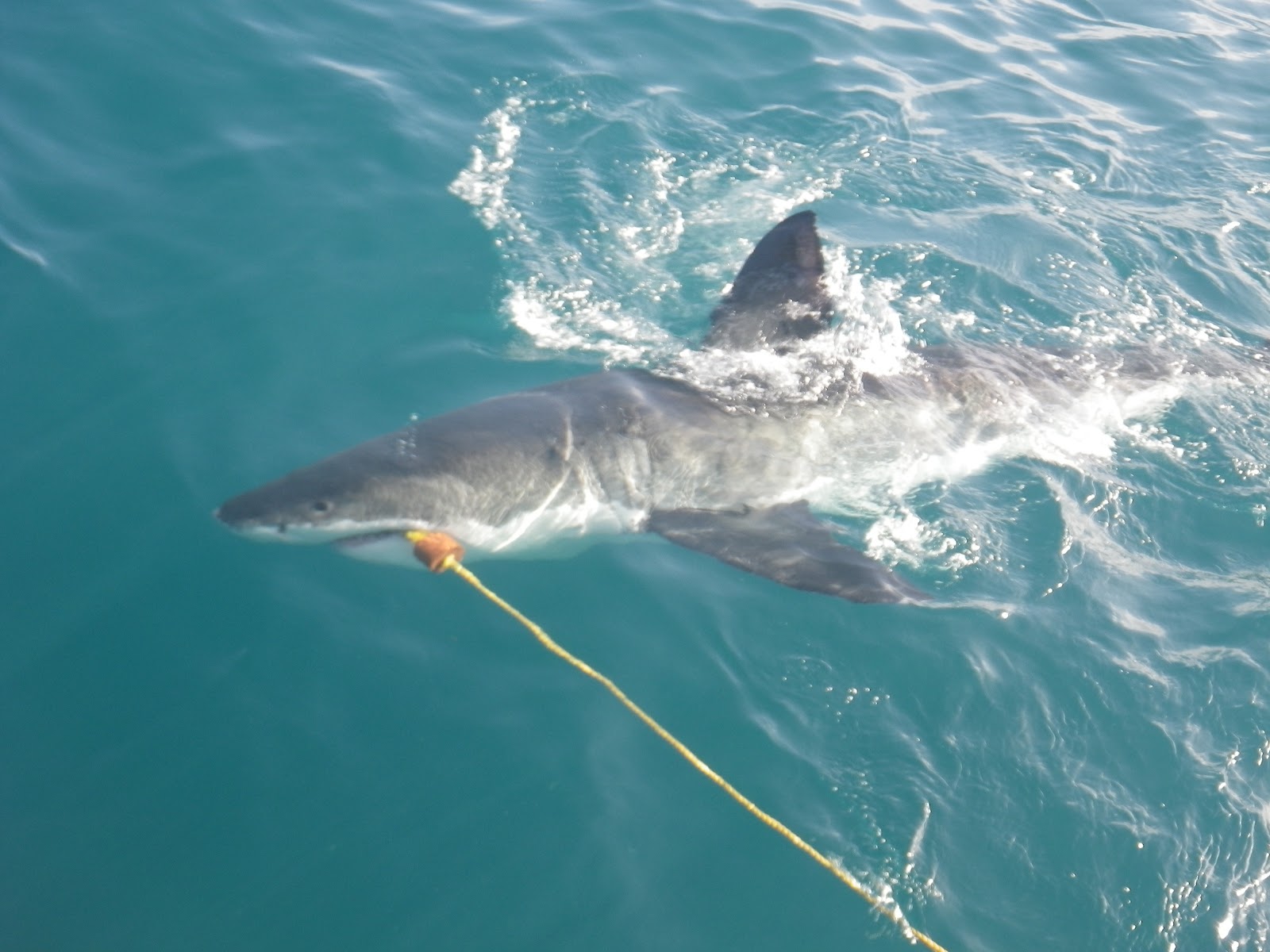
When I first found out I was travelling to Cape Town, I immediately envisioned myself doing two things—climbing Table Mountain and cage diving with Great Whites. When it comes to adventures, I’m a pretty motivated person, so with the help of my leftover birthday money, I set off on a cage diving adventure.
When we finally arrived at the venue, I was so excited I just wanted to get on the boat and go! After a quick lunch and a short presentation on great whites, we were off—in our bright orange raincoats.
All I could think as I stared at the great whites circling our ship was “Is this real life?” I’ll allow some pictures to speak for themselves—
The entire experience was unreal, plus we got some great pictures of a few of us in the cage—
After everyone had their chance to get in the cage, the boat headed toward the Gansbaii version of Seal Island. It was just that—a very small island that is home to what seemed like a million seals. I’ve never seen—or smelled--so many seals. It smelled like a million wet dogs. Needless to say, when the sharks hang around this island, they never go hungry.
The day came to a close as we headed back to shore. All of us were exhausted and in need of a shower, but excited to tell our tale to the remainder of our group when we got home. It was a phenomenal experience overall, and I would highly recommend seeing these magnificent creatures up close!
Stay tuned for my account of our climb to the top of Table Mountain!
-Kim
Tuesday, 12 July 2011
Zwelethemba
Zwelethemba, you have stolen my heart. Your sandy paths, mountain silhouettes, laughing children, and quiet survivors will stay with me forever.
Zwelethemba is a township on the outskirts of Cape Town in Worcester, which is about an hour and half away from UCT. We arrived Friday afternoon and met our homestay mothers. Valerie and I were paired with Nothemba, an elderly woman with a huge smile on her face. When she took us to her tiny brick house, we were surprised to see the number of children running in and out all day long.
When we first met Nothemba, she had three children and ten grandchildren. But by the time we departed, she only had two children. During our first night in Zwelethemba, Valerie and I awoke at midnight to chanting, singing, and praying. We were confused and slightly scared but decided to not leave our room. But in the morning, we were told that Nothemba’s daughter had passed away in the night. This was not the first child she had lost. This daughter left a pair of twins just learning to walk and a five-year-old son, Iviwe. Nothemba had already been taking care of these children, as her daughter had been sick for a year. The previous night Nothemba told us how she was getting old, and she was tired of taking care of so many children. I counted seven roaming around and coming in and out of the house throughout the day and I wondered how many actually lived with her.
After breakfast we were quickly transferred to another mother, because funeral preparations had to be made. The furniture was moved as neighbors, family members, and even Nothemba’s ex-husband visited her and offered their condolences. But no one uttered a word of how Nothemba’s daughter died.
For weeks I was working at an HIV clinic where I met patients testing positive for HIV, starting treatment, and either adhering to or defaulting treatment. Finally, I was put into a house with a family that experienced death from the virus. My experiences with HIV went from reading about it in medical journals at Hopkins to seeing it in a personal matter that I could never have imagined would occur on this trip.
On our arrival to Olga’s house, which was a minute walk from Nothemba’s, I was surprised by how quiet our second homestay was. Olga’s concrete house was much larger and did not have the dirt of children’s games smeared on the walls. And after a few hours of talking with Olga, I realized her stories painted a different picture.
Olga was a victim of the 1996 Shoprite bombing in Zwelethemba. A young, white man by the name of Stefaans Cotzee had worked with others to plant a bomb at the store where many black South Africans like Olga did their general shopping. After the bombing, she spent a year at the hospital receiving treatment on her badly damaged legs. The sound of the blast had also damaged her ears. The memories of the incident still keep her up every night and as a result, she can only sleep for a couple of hours.
Years later Olga heard from two German journalists that the perpetrators of the bombing had been caught and sentenced without her knowledge. With their help, Olga went to Pretoria Prison to visit Stefaans. There she was stunned to see a 31 year young man, when, for so long she had imagined him to be much older. When she asked him what he would give in return for her forgiveness, he could promise nothing for he had nothing. She was satisfied with this answer and so she forgave him. I never witnessed the meaning, the power, or the simplicity of forgiveness until I came to South Africa.
Because of the injuries from the bombing, Olga could no longer work or financially provide for her children and so her husband’s family took in her children. Her husband died in a hit and run accident a few years ago and the compensation she received in court for his wrongful death was used to build her house. Before she moved here, she lived fifteen minutes away in a tin shack with no electricity or running water. But even now that she has a roof over her head, she cannot pay the municipality bills. She will have to go to court soon to settle this or they will cut off her electricity and water. She showed us all the papers, including her court summons.
There are only two light bulbs inside the house, one in the hallway and one in the kitchen, and so we ate dinner in the dark in the living room. At dinner, Olga quietly confided in us that she is amazed that she is able to put food on her table. She has no job, children who look in after her, just friendly neighbors. She told us to take as much as we wanted and not to worry about her because she is a small eater. I know that she will save the leftovers for as long as she can because the money she gets from being a homestay mother is not much. This is not a meal where you take seconds.
Later that night, when everyone else went to the shebine, I sat down with Olga and gave her a small gift and she held me and started crying. Apparently, she had been living in the house for the past two days with no food. She is frail, lonely, and has no way of leaving Zwelethemba. If she leaves, where will she go? What kind of work can she find? What will happen to her house? She does not know and therefore, she does not leave. She said I was a miracle, because of the gift I had given her. She insisted I must have been a miracle, sent from both God and her friend Nothemba. She was losing faith in God the night before, and God was the only thing she had left.
As we left Zwelethemba the next day, Olga gave us many hugs and kisses, but she repeated that once again she will be all alone. The only comforting thing I came up with was to tell her that she had God by her side and when you have God you are never alone. She went off to church to pray for us.
As we waited for the van to pick us up, I saw Iviwe again. He is a naughty kid, who always makes trouble, but he still smiles genuinely every now and then and he is most relaxed when he is held. I asked Nothemba if he knows his mother has passed away. She said yes but he does not care much because she never took care of him.
As we said goodbye, Nothemba handed us a copy of her book, Not the End of the World, and I put it with my copy of Olga’s story that she had given me. Within the first few pages of Nothemba’s book, I learn that her name means hope.
The children of Zwelethemba, who have come to know our faces and love our presence in only three days, ran over to say goodbye. They love running their fingers through our hair, braiding and twisting it. They love throwing around Abe’s football, dancing with Sasha, and making funny faces with Jen. But most of all, they love running to us as we stroll the streets of Zwelethemba and fighting over who gets to hold our hands. I saw Ano with watery eyes as she asked me when I’ll come back and I told her that I don’t think I can. She came back with a tiny plastic bag with a sticker and a button. She wanted to give me a gift and that’s all she had. I hugged four-year-old Thama one last time, and in Valerie’s arm she sang a song in Xhosa after I had asked many times to hear her sing. As we drove off, Valerie asked me, how can they love us so much so quickly when we have done nothing for them. I reply that kids get attached easily and our presence, our games, our laps and shoulders provided an escape from their daily routines and households where parents were busy, neglectful, or absent.
The truth is, memories of the view of Table Mountain, the breathtaking scenery of the Cape Peninsula, and dinners at exotic restaurants will probably fade, but I cannot imagine forgetting the people I have met in South Africa. The people and stories of Zwelethemba will especially always stay with me.
Zwelethemba is a township on the outskirts of Cape Town in Worcester, which is about an hour and half away from UCT. We arrived Friday afternoon and met our homestay mothers. Valerie and I were paired with Nothemba, an elderly woman with a huge smile on her face. When she took us to her tiny brick house, we were surprised to see the number of children running in and out all day long.
After breakfast we were quickly transferred to another mother, because funeral preparations had to be made. The furniture was moved as neighbors, family members, and even Nothemba’s ex-husband visited her and offered their condolences. But no one uttered a word of how Nothemba’s daughter died.
Curious, I asked Olga, our second homestay mother, how Nothemba’s daughter died, but she did not answer. Later on, I heard it was AIDS and that she had refused treatment. She had refused to fight the death sentence. She had refused to care for her children. At our HIV panel that afternoon, a healthy, HIV positive woman adherent to treatment told us how she refused to become a victim of the death sentence, how she found the courage to disclose to others, and how she would continue to fight for the sake of her children.
For weeks I was working at an HIV clinic where I met patients testing positive for HIV, starting treatment, and either adhering to or defaulting treatment. Finally, I was put into a house with a family that experienced death from the virus. My experiences with HIV went from reading about it in medical journals at Hopkins to seeing it in a personal matter that I could never have imagined would occur on this trip.
On our arrival to Olga’s house, which was a minute walk from Nothemba’s, I was surprised by how quiet our second homestay was. Olga’s concrete house was much larger and did not have the dirt of children’s games smeared on the walls. And after a few hours of talking with Olga, I realized her stories painted a different picture.
Olga was a victim of the 1996 Shoprite bombing in Zwelethemba. A young, white man by the name of Stefaans Cotzee had worked with others to plant a bomb at the store where many black South Africans like Olga did their general shopping. After the bombing, she spent a year at the hospital receiving treatment on her badly damaged legs. The sound of the blast had also damaged her ears. The memories of the incident still keep her up every night and as a result, she can only sleep for a couple of hours.
Olga stands in front of her previous home during a tour of her old neighborhood.
Years later Olga heard from two German journalists that the perpetrators of the bombing had been caught and sentenced without her knowledge. With their help, Olga went to Pretoria Prison to visit Stefaans. There she was stunned to see a 31 year young man, when, for so long she had imagined him to be much older. When she asked him what he would give in return for her forgiveness, he could promise nothing for he had nothing. She was satisfied with this answer and so she forgave him. I never witnessed the meaning, the power, or the simplicity of forgiveness until I came to South Africa.
Because of the injuries from the bombing, Olga could no longer work or financially provide for her children and so her husband’s family took in her children. Her husband died in a hit and run accident a few years ago and the compensation she received in court for his wrongful death was used to build her house. Before she moved here, she lived fifteen minutes away in a tin shack with no electricity or running water. But even now that she has a roof over her head, she cannot pay the municipality bills. She will have to go to court soon to settle this or they will cut off her electricity and water. She showed us all the papers, including her court summons.
There are only two light bulbs inside the house, one in the hallway and one in the kitchen, and so we ate dinner in the dark in the living room. At dinner, Olga quietly confided in us that she is amazed that she is able to put food on her table. She has no job, children who look in after her, just friendly neighbors. She told us to take as much as we wanted and not to worry about her because she is a small eater. I know that she will save the leftovers for as long as she can because the money she gets from being a homestay mother is not much. This is not a meal where you take seconds.
Later that night, when everyone else went to the shebine, I sat down with Olga and gave her a small gift and she held me and started crying. Apparently, she had been living in the house for the past two days with no food. She is frail, lonely, and has no way of leaving Zwelethemba. If she leaves, where will she go? What kind of work can she find? What will happen to her house? She does not know and therefore, she does not leave. She said I was a miracle, because of the gift I had given her. She insisted I must have been a miracle, sent from both God and her friend Nothemba. She was losing faith in God the night before, and God was the only thing she had left.
As we left Zwelethemba the next day, Olga gave us many hugs and kisses, but she repeated that once again she will be all alone. The only comforting thing I came up with was to tell her that she had God by her side and when you have God you are never alone. She went off to church to pray for us.
As we waited for the van to pick us up, I saw Iviwe again. He is a naughty kid, who always makes trouble, but he still smiles genuinely every now and then and he is most relaxed when he is held. I asked Nothemba if he knows his mother has passed away. She said yes but he does not care much because she never took care of him.
As we said goodbye, Nothemba handed us a copy of her book, Not the End of the World, and I put it with my copy of Olga’s story that she had given me. Within the first few pages of Nothemba’s book, I learn that her name means hope.
The children of Zwelethemba, who have come to know our faces and love our presence in only three days, ran over to say goodbye. They love running their fingers through our hair, braiding and twisting it. They love throwing around Abe’s football, dancing with Sasha, and making funny faces with Jen. But most of all, they love running to us as we stroll the streets of Zwelethemba and fighting over who gets to hold our hands. I saw Ano with watery eyes as she asked me when I’ll come back and I told her that I don’t think I can. She came back with a tiny plastic bag with a sticker and a button. She wanted to give me a gift and that’s all she had. I hugged four-year-old Thama one last time, and in Valerie’s arm she sang a song in Xhosa after I had asked many times to hear her sing. As we drove off, Valerie asked me, how can they love us so much so quickly when we have done nothing for them. I reply that kids get attached easily and our presence, our games, our laps and shoulders provided an escape from their daily routines and households where parents were busy, neglectful, or absent.
Sarah Islam
PHS 2012
PHS 2012
Tuesday, 5 July 2011
Getting to the Point
Cape Point, that is!
On Saturday, July 2nd, we piled into the van with our able driver, Chris, and headed South - to the very South-western tip of the continent, as we would soon see.
We started with a drive through beautiful Hout Bay, which was most beautiful from a vantage point at Chapman's Peak for photos...I know I am not alone when I say that it was then that I wished we were here in January so that we could have dived in to enjoy the water lapping at the shore!
From there, we moved on to the Cape Point Nature Reserve, part of Table Mountain National Park, which stretches from the north end of Table Mountain (which 9 of the students hiked the next day, I might add! But that is another story...) all the way down to the Cape of Good Hope, which had originally been called the Cape of Storms. Highlights of the Point include the original lighthouse, quite high on the peak, built in 1857, and the secondary light house, erected in 1911 when it was finally clear that the original was simply not doing its job! It was too often completely obscured by clouds and fog to be of any use.
Then on to the Cape of Good Hope! We did, of course, HAVE to have a group shot there.
Onward up the eastern coast of the Cape, with a stop at Boulders Beach where the African (aka jackass) penguins are little fazed by the attention of the paparazzi, and were happy to show off for us their fuzzy young ones, much to our delight!
And a final stop at Kalky's, a good old fashioned fish 'n chip joint with live music, the smell of the sea, and hake, yellowtail, and calamari that simply couldn't be any fresher. A real highlight, and a recipe for a full belly after a long day of dramatic scenery! Yum.
Sunday, 3 July 2011
Site visit - Yabonga!
Material resources, raw personal commitment, and experience: in a very basic sense, they’re the three fundamental elements on which many public health ventures are founded. Ideally, dedicated and trained staffers work in pristine facilities, distributing baby formula, scheduling shots, or explaining STI prevention. Frequently, though, one finds a partial admixture of the three. The employees may have little experience in public speaking. Or maybe they’re interns who aren’t fluent in the local language. Or they work in a crumbling structure hardly able to cope with the crowds who need help.
Last Thursday offered a view into the different sorts of arrangements that can exist, as we visited two sites in the township of Samora Machel. The first was a clinic overseen by Yabonga, a local organization that offers a range of services but that focuses largely on AIDS transmission and therapy. Most of the staffers are in fact HIV-positive, and are thus able to partially dissolve, through their very presence and energy, suspicions that AIDS is simply incurable. In speaking about their experiences, moreover, they attempt to dispel the powerful local stigmas surrounding the virus. While we were there, we also saw an educator speaking to a group of new mothers, who were gathered in a relatively spacious waiting room that doubles as a lecture hall. The picture was generally rather impressive: committed, experienced individuals working in a healthy environment, replete with colorful posters and posted reminders.
But a second stop revealed that significant contributions can also be made in the absence of splashy resources. A few blocks from the clinic, a local woman ran a safe house for roughly 25 local kids between the ages of 5 and 13. Safe house, though, is perhaps overly generous: it was a single, low-ceilinged room at the back of a small township abode, erected directly on the sand dunes of theCape Flats . We pressed to see, but the room could only house about nine adults at a time. And instead of featuring professionally produced posters, the walls were hung with handmade illustrations, and a few handwritten songs. Overseen by a single female volunteer, the room embodied a sense of necessary modesty.
Was the second site thus less significant, or less effective, than the first? Not, it seemed, if judged by its goals: not for a preteen surrounded by violence, or for a seven-year-old whose father worked in the distant city and whose mother was attending a lecture at the clinic. Sure, it had less in the way of resources. But the sheer commitment of its overseer, and her clear experience in entertaining children, seemed to go a long way in offsetting the limitations of the structure in which she worked.
But a second stop revealed that significant contributions can also be made in the absence of splashy resources. A few blocks from the clinic, a local woman ran a safe house for roughly 25 local kids between the ages of 5 and 13. Safe house, though, is perhaps overly generous: it was a single, low-ceilinged room at the back of a small township abode, erected directly on the sand dunes of the
Was the second site thus less significant, or less effective, than the first? Not, it seemed, if judged by its goals: not for a preteen surrounded by violence, or for a seven-year-old whose father worked in the distant city and whose mother was attending a lecture at the clinic. Sure, it had less in the way of resources. But the sheer commitment of its overseer, and her clear experience in entertaining children, seemed to go a long way in offsetting the limitations of the structure in which she worked.
Guest blogger: Kerr Houston
Wednesday, 29 June 2011
Turkish Delights!
After a riveting evening lecture on the Apartheid by UCT's Professor Charles Villa-Vicencio, what better a way to continue exploring different cultures than to dine at an authentic Turkish restaurant? Six among our group chose to do just that, and all were thrilled by the delectable supper experience.
A taxi ride into Green Point and a short walk down the street brought us to the heavily-mirrored entrance of Anatoli’s, a venue that Natalie Stein had discovered in a guidebook. More mirrors guided us into the main dining area, where our host seated us at a long table covered with white paper and lit, almost romantically, by a single candle. Promptly, our jovial server brought tall glasses of water and offered us a large tray that buckled under the weight of a smorgasbord of different appetizers, from which we eagerly selected a half-dozen dishes. Grilled cheese, potato pastries, octopus, meatballs—as we sampled our choices, we deemed the variety of flavors and textures marvelous. Meanwhile, the server slid sliced hot loaves of bread directly onto the table (hence the necessity of the paper covering), and we broke off chunks of this crispy staple to complement our appetizers.
Although several among us claimed that their stomachs were already satisfied up to this point, the best was indeed yet to come. Our appetites successfully whetted, the server invited us into the kitchen, where we saw samples of the available entrees—including mince-filled pasta shells, lamb stew, baked eggplant with pine nuts, and kabobs of several species skewered across daggers. Each person indicated which of the delicious-looking creations was most to their liking, and we waited at our table until the main course made its grand entrance. Words cannot accurately describe the incredible tastes we experienced as we savored our dinner, but rest assured that this food delivered to us an absolutely fantastic introduction to Turkish cuisine.
Full to bursting though we were, we simply could not resist indulging in the desserts that our server offered on another large tray. One baklava, one rice pudding, and one flan-like custard later, our group unanimously felt that we had completed our evening in one of the most savory and enjoyable ways imaginable. Exiting the restaurant and accepting the final, final ingredient of the experience—lokum candy—at the door, no words but praise and gratitude escaped our very content mouths.
-Michael Dawedeit
Subscribe to:
Comments (Atom)